
Advanced 3D Dental Imaging for Woodstock, GA Patients — See More, Treat Better
When it comes to your oral health, the more clearly we can see, the better we can treat. Cone Beam CT (CBCT) imaging gives our Woodstock dental team a complete, three-dimensional view of your teeth, jawbone, nerves, sinuses, and surrounding structures — information that traditional flat X-rays simply cannot provide. At Dentistry of Olde Towne, we are proud to offer this advanced diagnostic technology right here in our Woodstock office, giving our patients access to the same precision imaging used in leading dental and surgical centers. Serving Cherokee County families since 1984.
What Is Cone Beam CT Imaging?
Cone Beam Computed Tomography — commonly called CBCT or Cone Beam CT — is a specialized form of X-ray imaging that captures hundreds of individual images in a single, fast scan and reconstructs them into a detailed, three-dimensional model of your oral and facial anatomy. Unlike traditional dental X-rays, which produce flat, two-dimensional images, CBCT allows our Woodstock dental team to view your teeth, roots, jawbone, TMJ, sinuses — and in extraordinary detail.
The scan itself takes only 20 to 40 seconds, involves minimal radiation exposure, and requires no injections or dyes. The resulting 3D images are immediately available for our team to review and discuss with you during your appointment.
_*]:min-w-0 gap-3 standard-markdown”>
When Is Cone Beam CT Imaging Used?
CBCT imaging is a powerful diagnostic tool that plays a critical role in planning and delivering precise dental treatment. At our Woodstock dental office, we use Cone Beam CT for a wide range of clinical situations, including:
- Dental implant planning — CBCT allows us to precisely measure bone volume, density, and the location of nerves and sinuses before implant placement, dramatically improving accuracy and safety (Dental Implants)
- Wisdom tooth evaluation — Identifying the exact position of impacted wisdom teeth and their relationship to the inferior alveolar nerve before extraction
- Endodontic (root canal) diagnosis — Detecting complex root canal anatomy, missed canals, fractures, and the extent of infection that may not be visible on conventional X-rays (Root Canals)
- Orthodontic planning — Providing a comprehensive view of tooth positions, root angulations, and skeletal relationships to guide treatment planning
- Pathology detection — Identifying cysts, tumors, bone lesions, and other abnormalities that may not be visible on standard radiographs
- Bone grafting planning — Evaluating bone volume and quality before grafting procedures in preparation for implants
How Is Cone Beam CT Different from a Regular Dental X-Ray?
Traditional dental X-rays — including bitewing, periapical, and panoramic films — produce two-dimensional images that can miss important three-dimensional details. Structures overlap in 2D images, which can obscure pathology or make precise measurements impossible.
Cone Beam CT eliminates this limitation by producing a true 3D representation of your anatomy. Our team can rotate, slice, and measure the images in any plane — providing a level of diagnostic precision that was simply not available to general dental practices even a decade ago.
Importantly, CBCT delivers significantly less radiation than a traditional medical CT scan while providing comparable detail of the dental and facial structures we need to evaluate.
What to Expect During Your CBCT Scan
Having a Cone Beam CT scan at our Woodstock office is quick, comfortable, and completely non-invasive:
- You will be asked to remove any metal objects such as jewelry, glasses, or removable dental appliances
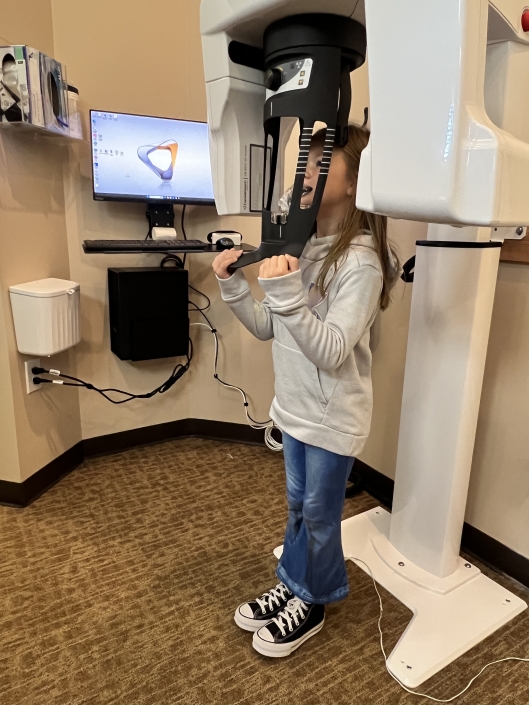
- You will be positioned standing or seated within the CBCT unit — the machine rotates around your head during the scan
- The scan takes approximately 20 to 40 seconds during which you simply hold still
- There are no injections, no dye, and no physical discomfort involved
- Images are immediately available for our team to review and discuss with you

Is Cone Beam CT imaging safe? How much radiation does it involve?
Yes — Cone Beam CT imaging is safe and uses significantly less radiation than a traditional medical CT scan. The effective radiation dose from a CBCT scan is comparable to a set of full-mouth dental X-rays and is well within the range considered safe for diagnostic dental imaging. The scan takes only 20 to 40 seconds, minimizing exposure time. As with all X-rays, we use CBCT only when the diagnostic benefit justifies the exposure, and we follow the ALARA principle — using the lowest dose necessary to produce the diagnostic information we need. If you have specific concerns about radiation, please discuss them with our Woodstock dental team before your scan.
Am I a candidate for dental implants?
Coverage for CBCT imaging varies significantly by insurance plan. Many dental insurance plans provide partial coverage when the scan is clinically indicated for a specific procedure such as implant placement, wisdom tooth removal, or endodontic treatment. Some plans classify CBCT as a diagnostic benefit, while others may require pre-authorization. Our Woodstock team will verify your coverage before the scan and provide you with a clear picture of any expected out-of-pocket costs. We will also provide the necessary documentation to support any insurance claim.
Does getting a Cone Beam CT hurt?
Not at all — a CBCT scan is completely non-invasive and painless. There are no injections, no physical contact with the imaging unit beyond positioning, and no discomfort during or after the scan. You simply stand or sit within the machine, hold still for 20 to 40 seconds while it rotates around your head, and the scan is complete. Most patients describe it as far easier and less uncomfortable than even a set of traditional dental X-rays.
Why can’t a regular X-ray give you the same information as a CBCT scan?
Traditional dental X-rays produce flat, two-dimensional images where structures overlap and three-dimensional relationships are lost. This can make it impossible to accurately measure bone volume, locate nerves precisely, or identify the full extent of pathology such as cysts or infections. A Cone Beam CT scan produces a true three-dimensional model of your anatomy that can be viewed, rotated, sliced, and measured from any angle — providing a level of diagnostic detail that is simply not achievable with conventional X-rays. For complex procedures like implant placement or impacted wisdom tooth removal, this precision can significantly reduce the risk of complications.
How long does it take to get the results of a Cone Beam CT scan?
One of the major advantages of CBCT technology at our Woodstock office is that the images are available immediately after the scan — there is no waiting for film to be developed or images to be sent to an outside facility. Our dental team can review and discuss the findings with you during the same appointment in most cases. For complex cases that require more detailed analysis or specialist consultation, we will schedule a follow-up conversation to walk you through the findings and treatment recommendations in full.